Why Are We Gradually Losing Our Ability to Feel Life?
I've been noticing something strange for a long time.
It seems to be getting harder for people to actually feel life.
Your favorite food still tastes good, but somehow it doesn't hit the same. You buy something you've wanted for months, and within a few days it feels ordinary. Music gets boring faster. Work starts feeling meaningless. Even money, relationships, travel, and experiences we once dreamed about can produce surprisingly little emotion.
I notice this especially among young people today.
Although, who am I kidding? It's not just young people anymore. Older people are getting lost in their phones too, hahaha.
And that observation led me to a personal hypothesis.
To be clear: this is not a scientific study that I conducted in a laboratory. It's my personal observation and an attempt to connect what I see around me with what neuroscience tells us about the brain.
I think we may be among the first generations in history to have almost 24/7 access to an enormous amount of instant stimulation.
And maybe our problem isn't that we have too little pleasure.
Maybe pleasure has simply become too easy to obtain.
1. First, let's understand dopamine properly
The brain uses chemical messengers called neurotransmitters to transmit and regulate signals between nerve cells.
One of the most famous is dopamine.
The internet loves calling dopamine the “happiness hormone,” but that's an oversimplification.
Dopamine plays an important role in motivation, reward learning, anticipation, and the drive to pursue something valuable.
In very simple terms, the brain is saying:
“This matters. Pay attention. Move toward it. Remember it. Maybe you should do this again.”
You're hungry and see food.
You're waiting for a message from someone you care about.
You're getting closer to a financial goal.
You win a competition.
You're anticipating sexual intimacy.
After months of work, you finally see results.
All of these can involve the brain's reward system.
But dopamine is only one part of a much larger system.
Serotonin, norepinephrine, oxytocin, endogenous opioids, glutamate, GABA, and many neural networks are involved as well.
So the equation
“dopamine = happiness”
is basically beautifully packaged b**lshit.
2. This is where my main idea begins
For most of human history, many rewards required action first.
Want food?
Find it.
Want money?
Work.
Want a relationship?
Meet someone, get to know them, survive some rejection, and build trust.
Want a strong body?
Train for months.
The basic pattern looked something like this:
DESIRE → EFFORT → WAITING → RESULT → REWARD.
Now look at what we've created.
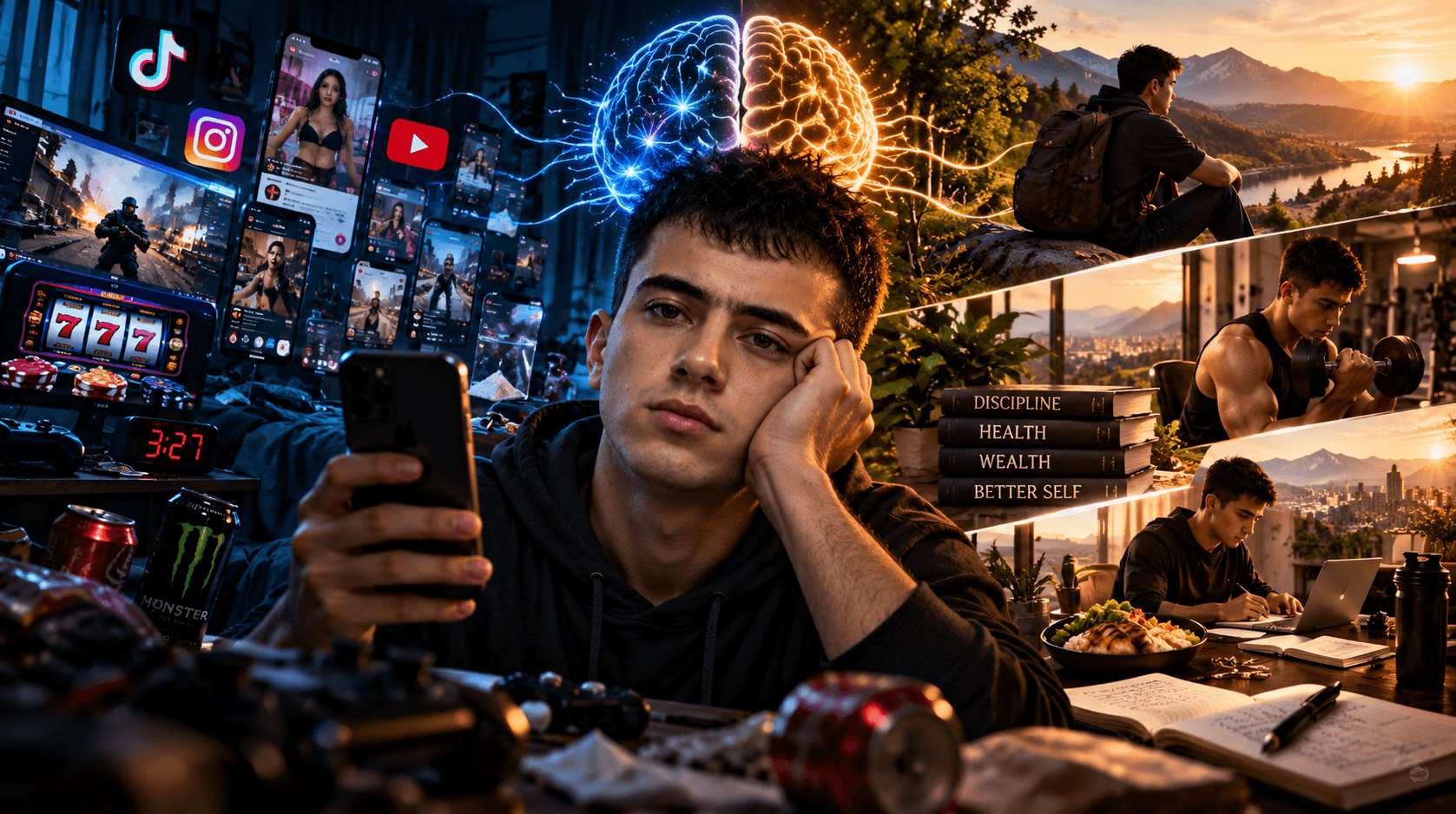
Drugs that can powerfully interfere with the brain's reward system.
Gambling and betting, where the next attempt might always be “the one.”
Video games with constant levels, victories, achievements, and rewards.
Social media with practically infinite content.
Then came Shorts, TikTok, and Reels.
Even sexual stimulation, which once required another human being to be physically present, can now be accessed through a screen through pornography and, when it becomes compulsive, masturbation.
In other words, we've sometimes reduced the distance between:
“I want it”
and
“I got it”
to a single movement of a finger.
3. Imagine the system as a button
Let's make this extremely simple.
Imagine your finger represents a stimulus.
There's a button in front of you.
You press it:
click → the light turns on.
Let's use the light as a metaphor for reward.
Now imagine that you can press that button almost endlessly.
Drugs → powerful reinforcement.
Betting → excitement.
Gaming → victory.
Shorts → novelty.
Porn → sexual stimulation.
Press.
Again.
Again.
Hundreds of small stimuli every day.
And this is where my hypothesis becomes interesting:
What if the modern problem isn't only the intensity of pleasure, but its frequency, accessibility, and speed?
In the past, there could be a week of work between desire and reward.
Today, sometimes there's only one swipe.
4. Are we “burning out” our dopamine receptors?
No.
I used to imagine it something like this myself:
If you keep hammering the same button endlessly, eventually it becomes less responsive.
As an analogy, it's useful.
But neurologically, saying that “your dopamine receptors are burned out” is inaccurate.
The brain is far more complicated.
With chronic exposure to certain substances and repeated behaviors, adaptive changes can occur in receptor function, neural connections, reward learning, and the brain's responses to cues associated with a particular behavior.
This has been especially well studied in drug addiction.
Tolerance can develop.
A certain dose used to be enough.
Eventually it isn't.
The person increases it.
Then increases it again.
In severe addiction, a person may eventually stop using the drug to chase the original high and start using it simply to avoid feeling terrible.
And constantly increasing the dose can eventually lead to overdose and death.
Behavioral addictions aren't identical to drug addiction, but reward learning still matters.
5. Here's the paradox that interests me most
We have more ways to entertain ourselves than almost any generation before us.
So why do so many people complain about:
boredom, lack of motivation, loneliness, emotional emptiness, and the feeling that “nothing excites me anymore”?
I'm not claiming:
“The internet destroyed humanity's dopamine.”
That would be ridiculously simplistic.
My idea is different:
Constant access to immediate rewards may influence our habits, attention, and relationship with the slower rewards of real life.
Because real life is slow.
Want a great body?
Months.
Want a profession?
Years.
Want to build a business?
You may work for years without even knowing whether it will succeed.
Want a healthy relationship?
Meeting people, rejection, mistakes, trust, responsibility.
But your phone says:
“Why the hl would you wait? Here, have something interesting right now.”**
Swipe.
A girl.
Swipe.
Money.
Swipe.
A meme.
Swipe.
Drama.
Swipe.
Sex.
Swipe.
News.
Another video.
Again.
Again.
Then you close your phone, open a book, and three minutes later wonder:
“Why does real life feel so damn slow?”
That's one of the most interesting questions of our time to me.
6. Then a dangerous loop can begin
A person increasingly chooses the easier reward.
They work less.
Study less.
Move less.
Take fewer risks.
Interact with fewer people in real life.
As a result, they achieve less in the real world.
Then they look at their life:
no money;
poor physical condition;
career going nowhere;
no meaningful relationship;
goals abandoned.
Their mood drops.
And what do we usually want when we feel terrible?
To stop feeling terrible as quickly as possible.
So we go back.
Phone.
Gaming.
Alcohol.
Betting.
Porn.
Endless content.
For a few hours, it feels easier.
But the real problem hasn't moved an inch.
The loop becomes:
FEEL BAD → QUICK REWARD → AVOIDANCE → NO REAL PROGRESS → FEEL WORSE → QUICK REWARD AGAIN.
And that's a pretty s**tty trap.
7. But blaming everything on dopamine is also wrong
The deeper you go into neuroscience, the more ridiculous it becomes to explain the entire human mind with one chemical.
Depression ≠ low dopamine.
Genetics, chronic stress, trauma, loneliness, sleep, physical illness, financial problems, social environment, and multiple biological systems can all play a role.
So my argument isn't:
“TikTok causes depression.”
My argument is more careful:
The modern environment may create conditions where immediate stimulation becomes incredibly easy to obtain while tolerating the long road toward delayed rewards becomes increasingly difficult.
Add loneliness, chronic stress, poor sleep, lack of purpose, and real-life problems to that equation, and you can end up with a pretty ugly mixture.
8. So what can we do?
The good news is that the brain has neuroplasticity.
It changes in response to repeated experience.
So if one lifestyle can strengthen certain habits, another lifestyle can gradually strengthen different ones.
This is where I find the basic idea behind a “dopamine detox” interesting, even though the name isn't scientifically accurate.
We're not actually detoxing dopamine from the brain.
The real idea is:
Stop feeding your brain a new stimulus every free second.
If Shorts are consuming your time, restrict them.
If you're automatically opening social media a hundred times a day, put limits in place.
If gaming has stopped being entertainment and become a way to escape your life, admit it.
If gambling controls you more than you control it, you're dealing with something more serious than a simple lack of willpower.
If porn and masturbation have turned into an automatic ritual that you repeat even when you don't really want to, taking a break can help interrupt the behavioral loop and restore a sense of control.
Not because you're “saving dopamine.”
Because you're trying to become the person making the decision again.
Drug addiction is a different level of problem and may require professional treatment.
9. Why do I compare it to fasting?
Imagine eating something every twenty minutes.
You almost never experience real hunger.
Eventually, even good food becomes ordinary.
But after fasting, even water and simple food can feel completely different.
I'm not saying the reward system literally works like the stomach.
It's an analogy.
The idea is simple:
Sometimes, to notice weaker signals again, we may need to stop constantly drowning them out with stronger ones.
And no:
“21 days.”
“90 days.”
“Six months and your receptors are completely restored.”
There is no universal magic number.
Recovery depends on the person, behavior or substance involved, duration of dependence, environment, sleep, mental health, and many other variables.
10. But removing stimulation isn't enough
Imagine deleting TikTok.
Quitting gaming.
Stopping porn.
And then spending the next six months lying in bed staring at the ceiling.
What did you build?
Nothing.
That's just another form of b**lshit.
It's not enough to remove old rewards.
You have to create new sources of real reward.
Exercise.
Work.
Proper sleep.
Real people.
Learning.
Projects.
Relationships.
Walking.
Difficult tasks.
Things where there is once again a journey between desire and reward.
And maybe one of the most important abilities we need to relearn is surprisingly simple:
the ability to be bored.
Not pulling out your phone the second nothing is happening.
Not watching a video with every meal.
Not constantly needing background stimulation.
Not demanding a new emotion every minute.
Sometimes allowing your brain to understand:
“Nothing exciting is happening right now. And that's completely fine.”
In the end, my personal hypothesis is pretty simple.
Maybe the problem with our generation — although, let's be honest, it's not just our generation anymore; older people are disappearing into Shorts too, hahaha — isn't that the world has stopped giving us pleasure.
Maybe we've increased the speed, frequency, and accessibility of stimulation so dramatically that ordinary life feels too quiet by comparison.
And if that's even partially true, the solution isn't to search for an even stronger high.
It's to recover our ability to feel the quieter things again.
Food.
Music.
Conversation.
The exhaustion after a workout.
Anticipating seeing someone.
Silence.
The result of months of work.
Life itself.
Because the dangerous point isn't when a person enjoys pleasure.
It's when, without constant stimulation, they can barely feel life at all.